Inside Althexis

Perspectives on AI, health, skincare, pharmacy business and updates on our work

March 28, 2026
2 min read
Antonis Nikitakis
Why knowledge alone won't fix the Consultation
The pharmacist doesn’t lack knowledge. Never did. Years of training. A degree in pharmaceutical sciences. Deep understanding of skin biology, active ingredients, contraindications. The expertise is real. But to the customer standing across the counter, the pharmacist’s reasoning is a black box. They look at your skin — but that mental image, and the thinking […]
Read more
Why knowledge alone won't fix the Consultation
March 28, 2026
2 min read
Antonis Nikitakis

The pharmacist doesn’t lack knowledge. Never did.

Years of training. A degree in pharmaceutical sciences. Deep understanding of skin biology, active ingredients, contraindications. The expertise is real.

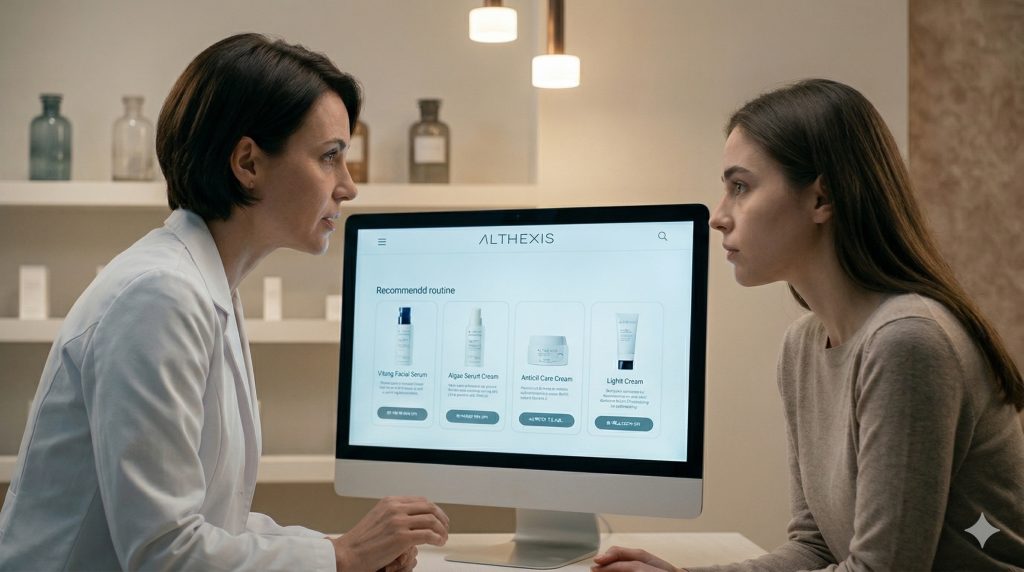
But to the customer standing across the counter, the pharmacist’s reasoning is a black box. They look at your skin — but that mental image, and the thinking behind it, never materializes for you.

What you finally see is an expert pointing at a shelf. You don’t see the differential thinking: this skin type, this concern, this product class. You don’t participate. You just see a hand pointing.

And so you wonder: is this based on my skin, or on what they have in stock?

What actually changes the consultation is the physicalization of the expertise. Turning the pharmacist’s internal reasoning into a shared process you can see, follow, and be part of.

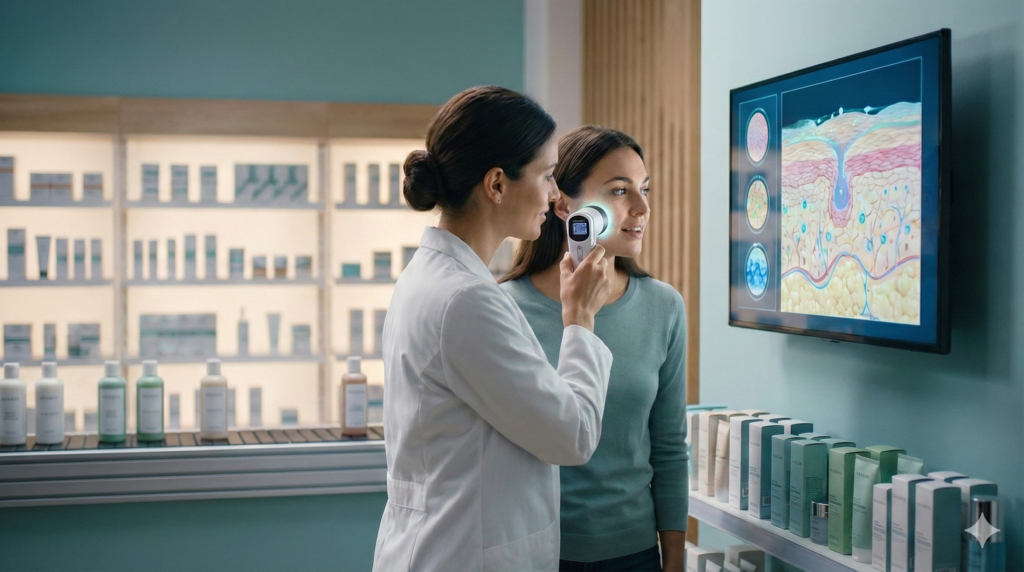
The moment the Althexis system comes out, the room reorganizes. Not because it’s a physical object. A phone with a skin app is a physical object too.

It’s because it signals the start of a scientific process. Both, pharmacist and customer, are now inside the same sequence: analysis, discussion, recommendation. A conclusion that neither person scripted. It built itself, in front of both of them.

This is the difference between information alone and physical presence. And it is vast.

Practically: the consultation now has shape. A ritual with steps that cannot be skipped.

Psychologically: you’re no longer receiving a verdict. You’re inside the process. You can stop, ask, push back. The analysis is yours as much as it is the pharmacist’s.

That feeling of being truly seen rather than sold to signals a cultural shift. A structural transformation. The data and the knowledge, in that moment, become visible. Trustworthy. Yours.

The conclusion?
You can’t trust a decision you weren’t meaningfully part of making.


Antonis Nikitakis
Co-founder & CEO, Althexis

#Pharmacy #SkinHealth #HealthTech #PharmacyInnovation #Skincare #PhysicalRetail #Althexis

January 13, 2026
2 min read
Antonis Nikitakis
Pharmacies in the Age of AI Shopping Agents
Imagine a world where your skincare routine is chosen not by you, but by an AI agent, quietly researching, comparing, and purchasing products while you sleep.  By 2026, this won’t be science fiction. It will be everyday reality. As autonomous shopping agents become capable of executing purchases through emerging protocols like UCP and AP2, the […]
Read more
Pharmacies in the Age of AI Shopping Agents
January 13, 2026
2 min read
Antonis Nikitakis

Imagine a world where your skincare routine is chosen not by you, but by an AI agent, quietly researching, comparing, and purchasing products while you sleep. 

By 2026, this won’t be science fiction. It will be everyday reality. As autonomous shopping agents become capable of executing purchases through emerging protocols like UCP and AP2, the way we buy skincare is about to change—fast.

But here’s the problem: these agents operate in a vacuum of biology. They can analyze reviews, track trends, and optimize for price, but they cannot see your skin. They don’t know your sensitivity, your barrier health, or how your skin reacts to niacinamide on a humid Tuesday. They buy based on metadata, not skin data.

The Trust Gap in the Age of Automation

When AI agents start making skincare decisions, the risk isn’t just poor product matches, it’s the erosion of trust in science. Consumers will unknowingly receive routines built on popularity, not physiology. And as online shelves fill with algorithmically recommended products, the line between marketing and medical advice will blur beyond recognition.

This is where pharmacies become essential, not as relics of the past, but as the future’s frontline of trust. The local pharmacy is the last physical space where science, care, and personal connection converge. It’s where a trained professional can look at your skin, listen to your concerns, and say: “This is what your skin actually needs.”

This new culture is built on two pillars: trust in science and respect for personal needs. Objective data reveals the skin’s state. But the customer’s voice: what they want, what they value, what they can maintain is the human layer. The best solutions don’t ignore either. They weave them together.

Pharmacies as Accessible Science Hubs

In the age of AI shopping agents, pharmacies have a unique opportunity: to become the Trust Anchor; the only place where science is verified before the transaction happens. This isn’t about resisting technology. It’s about elevating it.

With tools that capture real, medical-grade skin data, like Althexis Skicare Suite’s non-invasive imaging and AI-powered analysis, pharmacies can offer something no online agent ever could: personalized, science-backed recommendations grounded in biology, not buzz.

This is how we protect consumers. This is how we restore meaning to skincare. And this is how pharmacies reclaim their role as guardians of health, not just sellers of products.

Learn more about Althexis here: althexis.com

January 08, 2026
3 min read
Antonis Nikitakis
Why Pharmacies Are the Future of Skincare
Skincare today is louder than ever but not always wiser. Social media floods us with fleeting trends, miracle ingredients, and one-size-fits-all routines. Yet behind the noise, one truth remains: every person’s skin is unique. What works for a glowing influencer may disrupt your barrier, irritate your complexion, or simply fail to deliver. The real future […]
Read more
Why Pharmacies Are the Future of Skincare
January 08, 2026
3 min read
Antonis Nikitakis

Skincare today is louder than ever but not always wiser. Social media floods us with fleeting trends, miracle ingredients, and one-size-fits-all routines. Yet behind the noise, one truth remains: every person’s skin is unique. What works for a glowing influencer may disrupt your barrier, irritate your complexion, or simply fail to deliver. The real future of skincare isn’t in another viral serum or another app that guesses your skin type from a selfie. It’s in the quiet, trusted space of the local pharmacy where science meets care, and where every person is seen as more than a demographic.

Skin Is Not a Trend, It’s a Living Story

Your skin changes daily: with the weather, your sleep, your stress, your hormones. Yet most skincare decisions are still made in the dark, based on guesswork, anecdotal advice, or marketing claims. This is where the current system falls short. People deserve better than trial-and-error routines that waste time, money, and hope.

True skincare starts with understanding. Not assumptions. Not trends. But objective insight into the skin’s real condition which is measured, tracked, and interpreted with precision. That requires more than a quick glance in the mirror or a fancy new AI app on the phone. It demands tools that see beneath the surface.

The Pharmacy as a Hub of Trust and Science

Pharmacies have long been pillars of community health. They’re where people should turn for help or advice, not just products. Pharmacists are trained professionals, trusted for their knowledge and objectivity. In an era of volume vs quality of information, this trust is invaluable. But trust alone isn’t enough. To deliver truly personalized care, pharmacies need science-backed tools that turn subjective opinions into actionable insights.

Imagine a pharmacy where every customer receives a quick, non-invasive skin scan that maps hydration, pigmentation, texture, and sensitivity in real time. Where data replaces assumptions. Where recommendations are built on what the skin actually shows, not what a label claims. This is no longer science fiction. This should be the new standard.

Personalization That Listens—To the Skin and the Person

Although skin measurements are key, the best skincare isn’t just about data. It’s about dialogue. A scan reveals the skin’s state, but the customer brings the rest: their goals, their lifestyle, the textures they love, the routines they can maintain. The future of skincare lives in the balance between objective measurement and personal experience. It’s not just what the skin needs—it’s how the person wants to care for it.

A New Culture of Care is Built on Science and Respect

We’re not just changing how skin is analyzed. We’re changing how it’s understood. A new culture is emerging, one where skincare is not a gamble, but a conversation. Where pharmacies become the first point of personalized skin health, not just the last stop before a dermatologist. Where manufacturers gain deeper insight into real-world product performance, not through surveys, but through real skin data. Where customers finally feel seen.

This culture is built on two pillars: trust in science, and respect for subjectivity. It’s not about replacing human connection with machines. It’s about empowering it.

The future of skincare should not be based on another trend but on science and dialogue. It’s in the moment a customer walks into a pharmacy and thinks: Finally, someone pays attention to my skin—and to me.

That future starts now.
And it starts in pharmacies.

Learn more about Althexis here: althexis.com